
Life is not a spectator sport, it only rewards action takers.
Busy Mums know this better than anyone, and this is one of the maxims we live by in our household with six young kids (including a newborn!).
If you aspire to something, do something to make it happen!
Like anything, wealth is achievable no matter who you are.
You just need to choose the right path to arrive at your desired destination.
It’s a well-worn road that allows you to maximise your potential to accumulate while minimising the likelihood of losses.
Anyone can take this high road – deckhands to doctors, labourers to lawyers, working mums to merchant bankers.
It just requires discipline and determination to stay on course.
I like to think of it as a practical roadmap for people to navigate each phase of their life.
It allows them to enjoy the present whilst preparing diligently for the future.
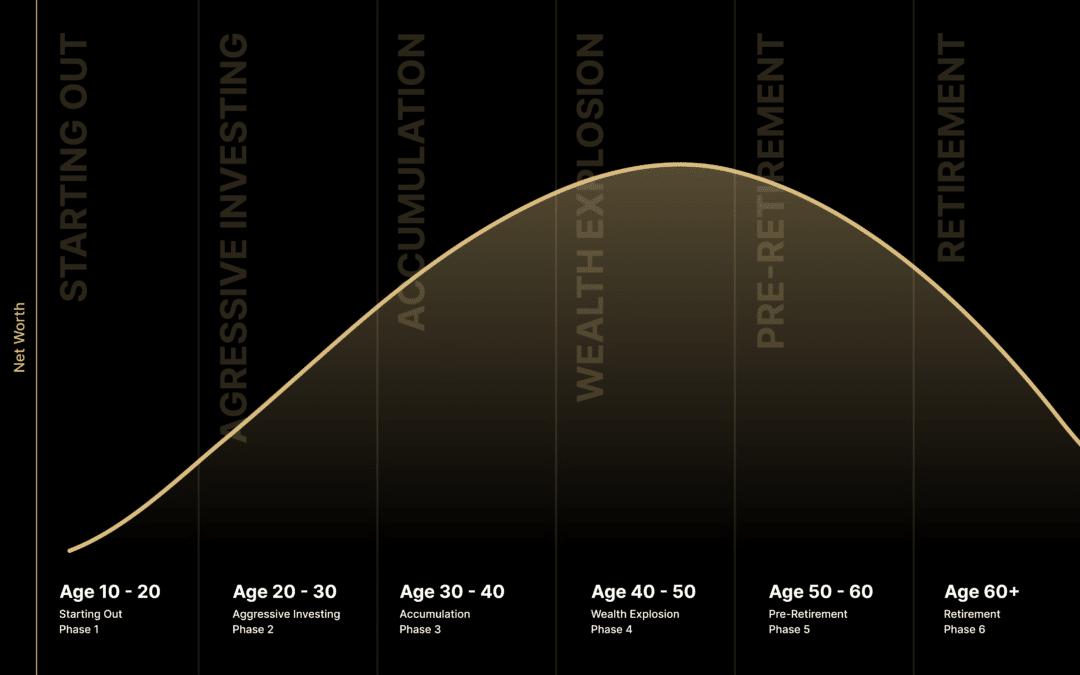
As shared in my book The Wealth Playbook, I have separated life into six phases of investing, divided by decades.
The ages mentioned below are just a guide – it’s never too late, even if you feel behind or you’ve faced financial hardships.
Depending on your financial health, you may need to play catch-up and work that little bit harder than others to achieve the same end goal, and that’s ok!
View these phases not only in the context of your own life, but also your children, and consider how you can empower them on their wealth journey as well.
Starting out (Ideal age 10-20 years)
Young people have time on their side and the more time your money is in the market working for you, the more you stand to gain.
That’s why understanding the principles of saving and investing are so important from an early age – start teaching and planning with your kids as soon as possible.
A longer time horizon also gives young people the luxury of being able to invest aggressively with the ability to ride out market fluctuations, even severe crashes like in 2008.
They should hence be drawn to high growth stocks, ETFs and steer whatever is left into high-interest savings accounts.
Many young people don’t know what they want to do in life, even after they have left school.
There’s nothing wrong with that but it shouldn’t prevent them from beginning their wealth accumulation journey.
Their primary objectives should be to gain employment or a part-time job if studying and to begin putting money aside for an emergency fund and a house deposit.
It is the perfect time to start thinking about what they want out of life and to set some future goals to help them get there.
Aggressive Investing (Ideal Age 20-30 years)
This is a critical period where you hopefully settle into your chosen career and start increasing your earnings.
The key however is to do so while increasing your investing rather than your spending.
Surplus cash should be channelled towards higher risk, high growth investments.
The odd loss should not discourage an all out assault on chasing maximum returns.
People in their 20s need to prioritise paying off student debt and should aim to buy their first property around the age of 25.
With that achieved, it is well within their grasp to purchase their first investment property by age 28.
Accumulation (Ideal age 30-40 years)
The 30s is a critical decade on the road to financial freedom.
It is about accumulation and aggressively growing your investment portfolio with the benefit of the higher income your family will hopefully be earning.
To do this, your priority should be eliminating high-interest debt, enabling you to divert your resources towards wealth creation.
There should now be an increased focus on investing in property, as well as stocks, ETFs, maintaining a high growth mindset but without taking unnecessary or stupid risks.
Consider expanding your property portfolio as your rental income increases.
If you are a well-established high-income earner, a self-managed super fund (SMSF) may be beneficial as you start seriously planning for your retirement.
Wealth explosion (Ideal age 40-50 years)
If you were paying attention in your 20s, you would know that by your 40s, the power of compounding begins to supercharge your wealth.
It’s a critical time to review your portfolio to ensure it remains aligned with your goals and is optimising your tax benefits.
It’s also vitally important to have maximum income protection insurance to guard against ill-health derailing your plans and ensuring your family is protected.
Continue to invest moderately to aggressively and you may even allow yourself a small side bet on an ‘exotic’ or high risk investment.
Pre-retirement (Ideal age 50-60 years)
As people enter the pre-retirement phase in their 50s, the first thing they need to retire is their debt.
It may require selling some property assets as the focus shifts from negative gearing to positive income flow.
That includes a greater focus on stocks that pay dividends rather than ones with growth potential.
It’s also a time to dial back the risk profile of investments to a conservative level to protect assets from serious exposure to market crashes.
It is also a time where focus increases on legacy, where investing in your family’s long-term, multi-generational future may become a greater priority.
Retirement (Ideal age 60+ years)
If you have remained on course, you can now look forward to reaping the rewards of your patience, dedication and hard work.
Your diverse portfolio of assets should mitigate your risk exposure and be paying you dividends that will represent your income for the rest of your life.
With a fixed income, you will now need to budget even more carefully and watch what you spend.
But remember, life is meant to be lived with those you love. So it is essential to shift your mindset from a saving to spending mentality, and enjoy the fruits of your success!
_____________________________________________________________________________________________________________________________
Andrew Baxter is an investment coach, leading trader and Dad of six young children. He’s the author of best selling book, The Wealth Playbook: Your Ultimate Guide To Financial Security, and founder of Australia’s top trading education platform, Australian Investment Education.